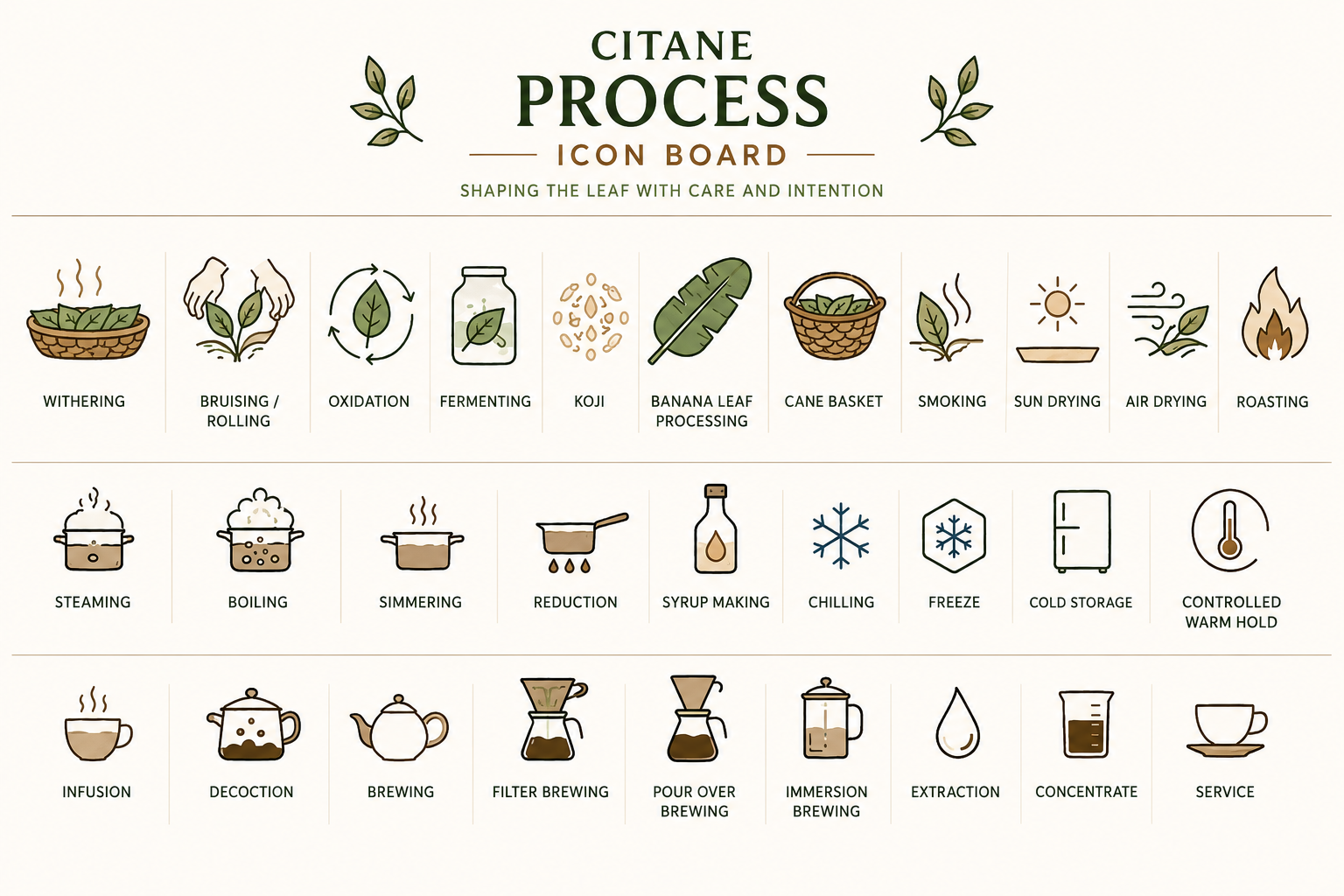
Tap image to view full board.
The vocabulary of what is done to the leaf between harvest and cup. Processing methods, brewing methods, and traditional equipment.
Tap image to view full board.
Citane processing at Thumpassery draws on published Arabica leaf research and Citane's own field observations. Methods range from traditional decoction (Engere, Kuti) to oven-dried oolong-style preparations documented in current research.
Allowing harvested leaf to lose moisture at ambient temperature over a controlled period. The first active processing step. Duration determines the degree of enzymatic preparation before the next stage.
None →Light physical disruption that initiates enzyme activity without committing to full oxidation. Gentler than rolling — begins the flavour development process with more control.
None →Mechanical working of the leaf to rupture cell walls and bring enzymes into contact with substrates. Controls the depth and character of oxidation. The intensity of rolling determines the processing pathway.
None →Enzymatic transformation of polyphenols when damaged leaf is exposed to air. The degree of oxidation — from minimal (green) to full (black) — determines the colour, body, and flavour register of the final product.
None →Microbial transformation of the leaf using yeasts, bacteria, or Koji. Creates new flavour compounds not accessible through enzymatic or thermal processing alone. Requires controlled conditions and careful monitoring.
None →Brief exposure to steam to halt enzymatic activity and lock the leaf in its current chemical state. Used to produce green-style Buna. Requires speed after harvest.
None →Dry heat applied via a flat pan to arrest enzymes and begin flavour development simultaneously. Used in Kuti and some Chemo preparations. Creates initial roasted character.
None →Exposure to wood smoke — the defining step in Kawa Daun preparation. Cinnamon wood (Cinnamomum burmannii) is traditional. Smoke infuses volatile aromatic compounds into the leaf.
None →Drying leaf in direct sunlight. Slower than oven drying, with different compound development. Produces white-style Buna character. Weather-dependent and variable.
None →Drying leaf away from direct sunlight. Gentler than sun drying. Retains more delicate volatile compounds. Preferred for preservation of subtle aromas.
None →Controlled heat-based drying at a fixed temperature. More consistent than sun or shade drying. Standard approach in Citane research preparations. Temperature and duration both matter.
None →Drying using ambient airflow without direct heat or sunlight. Slow. Produces specific compound retention profiles. Often used for post-fermentation drying.
None →Separating leaf by size, maturity, or condition. Removes off-quality material and creates batch uniformity. An undervalued step — sorting is quality control made visible.
None →A woven vessel used in traditional preparations. Provides airflow and breathability during holding or gentle drying. Specific traditions of use vary — see individual tradition pages.
None →The round-bottomed Ethiopian clay pot used for Chemo and Engere preparation. Clay heats gently and evenly. Central to the ritual of Ethiopian coffee leaf preparation.
See Chemo →TraditionalBoiling leaf material directly in water for an extended period. The traditional method for Kuti, Engere, Kawa Daun, and Chemo. Extended decoction may reduce bitterness and perceived astringency.
None →Steeping leaf in pre-heated water without further boiling. The method common to most Camellia sinensis tea preparation. Some Buna preparations use infusion, particularly for green-style.
None →Extended extraction in cold water over several hours. Reduces bitterness and astringency. Changes the compound extraction profile compared to hot methods.
None →A strong preparation intended for dilution or for use as an ingredient in other preparations. Produced by a higher leaf-to-water ratio or extended extraction.
None →The cane basket appears in traditional processing documentation as a general vessel type. It is not specifically attributed to Chemo or Engere in the published research reviewed for this library. Its traditional association with Ethiopian preparations is plausible but has not been confirmed in peer-reviewed sources.