Chandragiri Arabica under rubber shade at ~130 m, Karavaloor, Kerala. Citane processing draws on four documented coffee leaf traditions and original field research at Thumpassery. These ten steps apply differently in each tradition — and differently again in Citane's own emerging practice.
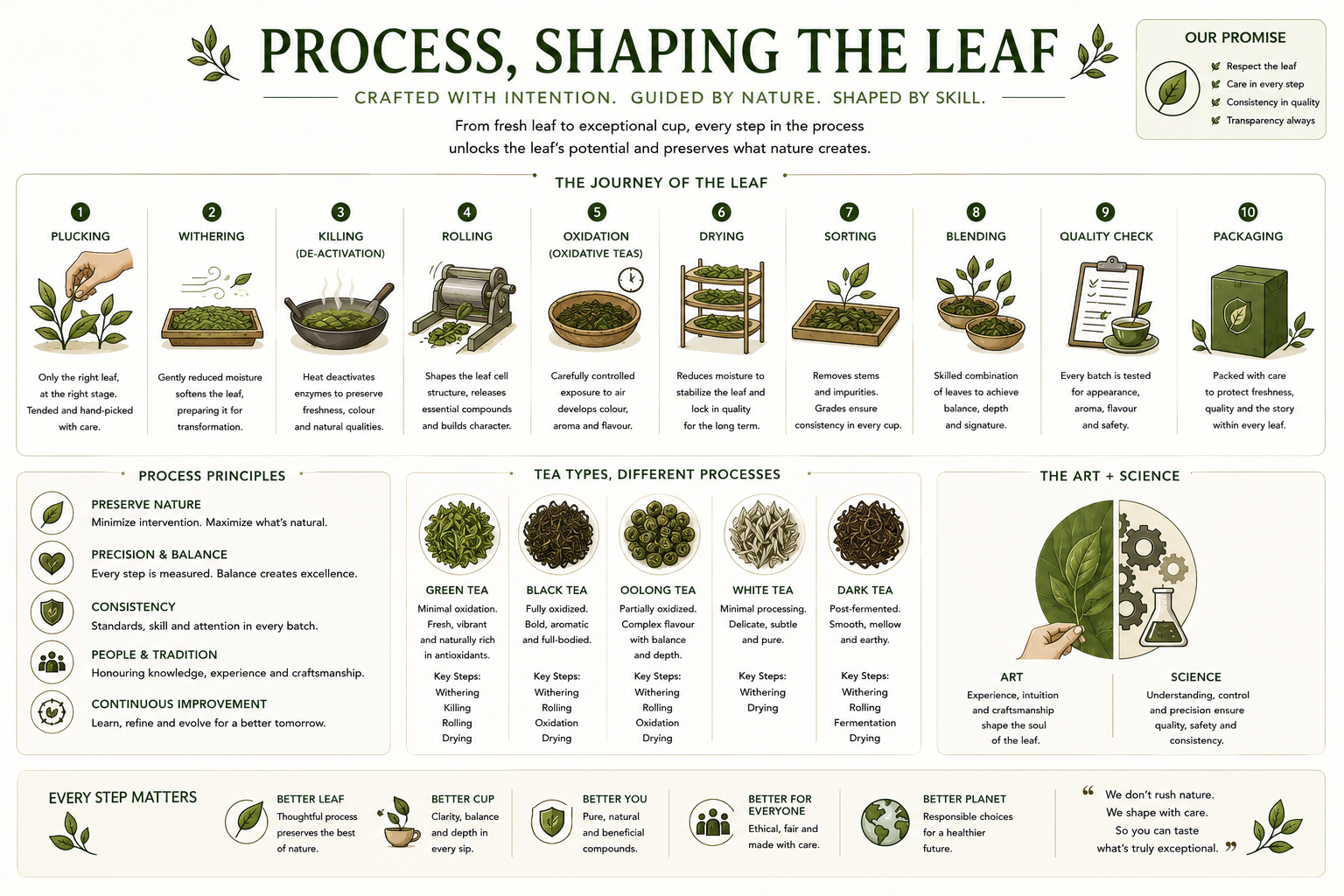
Reference image — Process, Shaping the Leaf: ten steps, process principles, four documented traditions.
Selective removal of the leaf at the correct maturity stage. The first and most consequential processing decision — no downstream step can compensate for wrong-stage harvest.
See Selective Harvest → ResearchControlled moisture reduction that softens the leaf and prepares it for transformation. Duration, temperature, and airflow are all active variables.
See Withering → ResearchApplying heat to deactivate polyphenol oxidase and lock the leaf in its current state. Used to produce green-style Buna. For oxidative styles, this step is delayed or omitted.
See Thermal — Enzyme Arrest → ResearchPhysical disruption of cell walls to release compounds and initiate or deepen oxidation. Degree of rolling determines whether the pathway leads toward green, oolong, or black character.
See Bruising / Rolling → ResearchControlled exposure to air that develops colour, aroma, and flavour. The degree of oxidation is one of the most significant processing decisions — it fundamentally changes cup character.
See Oxidation → ResearchMicrobial transformation that creates new flavour compounds not achievable through physical or thermal processing alone. Not all pathways include this step.
See Fermentation → ResearchMoisture reduction to storage-stable levels. Method, temperature, and duration all affect volatile retention and final character. Insufficient drying risks mould; excessive drying loses aromatics.
See Drying Methods → ResearchRemoving off-quality material and creating batch uniformity. The final quality gate before packaging — what passes sorting is what goes into the cup.
ObservedSensory and documentary verification that the batch meets intended standard. Records from quality checks feed back into process improvement.
See Traceability → ObservedThe last line of defence against moisture, light, and oxygen. Packaging choice protects everything the previous nine steps produced.
See Environment — Packaging → ObservedThe best processing amplifies what the leaf already is. Every step should have a reason, and the reason should be the leaf.
Each variable is understood, monitored, and adjusted. Balance is the outcome of precision applied with experience.
Built through documented practice. The promise to the person who buys Buna that what they experienced last time is what they will experience this time.
Processing knowledge is partly scientific and partly held in the hands and judgement of experienced practitioners. Both are legitimate and both are needed.
Every batch offers data, every season offers learning, every cup offers feedback. The commitment to improvement separates a living practice from a fixed routine.
Note on the traditions below
Engere, Kuti, Chemo, and Kawa Daun are documented traditions — each with a published research basis. Citane is an emerging practice at Thumpassery Estate, informed by these traditions and by original field research. It is not yet a tradition in the same sense. The distinction matters.
Coffee leaf brew decocted then combined with fresh cow's milk. Three preparation variants documented. Consumed by all household members. Safety record documented across 385 households.
See Engere → Traditional ResearchFallen or dried yellow leaves boiled for a minimum of 30 minutes. Salt added before boiling. Extended decoction is the method, not a shortcut — the longer boil reduces perceived bitterness.
See Kuti → Traditional ResearchRobusta leaves smoke-dried over cinnamon wood. Brewed by decoction. Served in coconut shell. Predates Dutch colonial period. Smoking is the defining processing step.
See Kawa Daun → Traditional ResearchArabica Chandragiri under rubber shade at ~130 m, Karavaloor, Kerala. Oolong-style and experimental processing pathways. An emerging practice informed by the four documented traditions and by Citane's own field research — not yet a tradition in the documented sense.
See Process Compass → ObservedEvery step connects to the next
Great processing is not about any single step — it is about the coherence of the whole journey. The leaf that enters Step 1 and the cup that results from Step 10 are connected by every decision made in between.