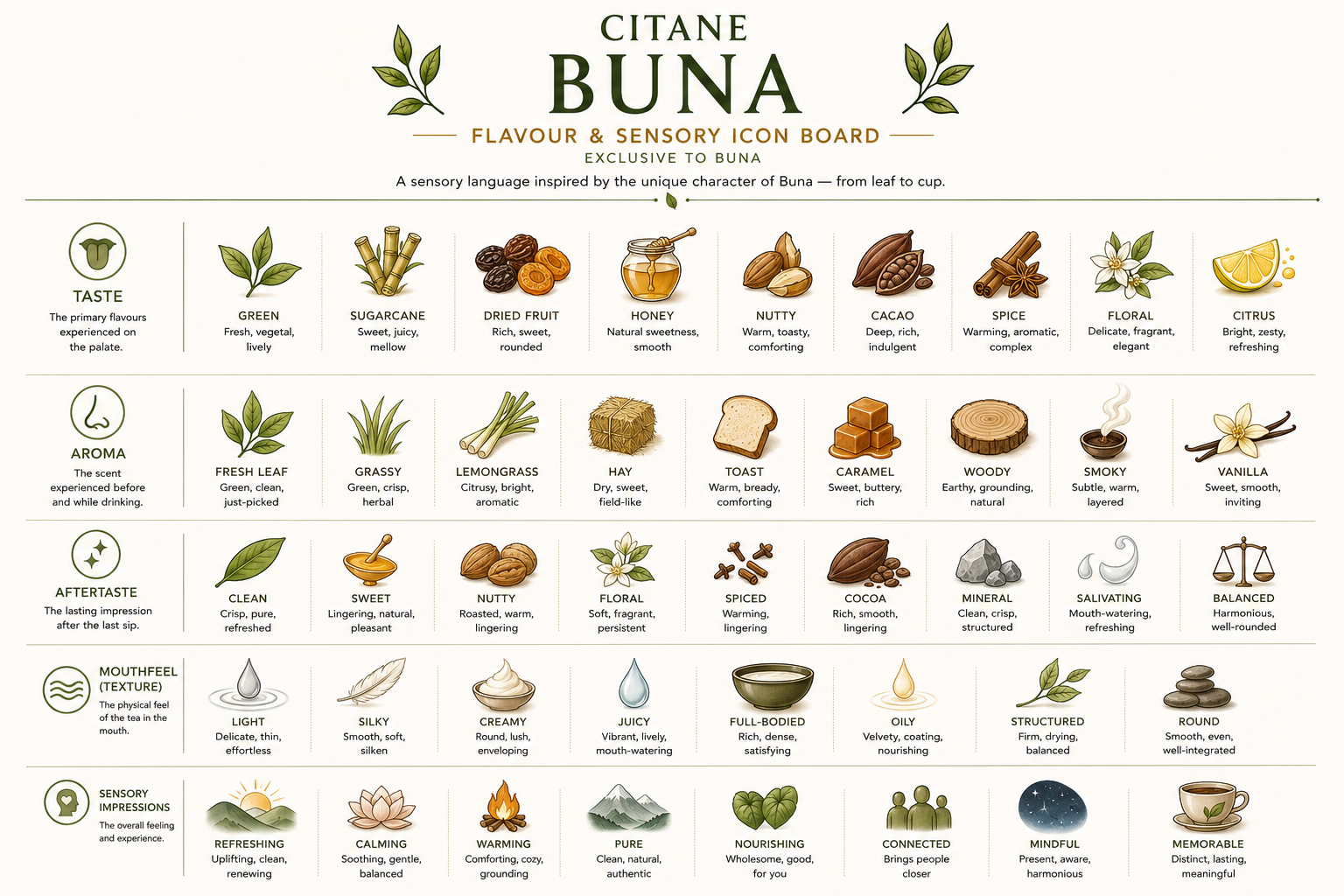
Tap image to view full board.
Primary taste and aroma vocabulary for Buna. Terms are grounded in peer-reviewed research where possible. Where they are not, they are clearly marked Observed or Hypothesis.
Tap image to view full board.
Citane is Arabica Chandragiri processed under rubber shade at Karavaloor, Kerala. Its sensory character is shaped by lowland altitude, shade growing, and the processing pathway applied. Evidence tags on each term indicate its basis in research, observation, or hypothesis.
The dominant positive sensory attribute in optimised Buna preparations. Associated with hydroxyl compounds, sugars, and amino-peptide complexes. In oolong-style processing, sweetness is the primary driver of consumer preference.
None →Present in coffee leaf, but documented as low in oolong-style preparations (Fibrianto et al. 2025). Driven by chlorogenic acids, tannins, and caffeine. Decreases with optimised brewing parameters.
None →One of four primary sensory attributes studied in coffee leaf research. Present but not dominant in optimised preparations. Influenced by organic acid content and brewing conditions.
None →The drying, puckering mouthfeel caused by tannin-protein binding. Driven by polyphenol and TPC content. Decreases with optimised brewing temperature and duration, and with cold serving.
None →Savour associated with free amino acids. Amino acids are documented in coffee leaf (Cangeloni 2022). Whether umami is perceptible in brewed Buna has not been established in peer-reviewed sensory research.
None →The characteristic aroma of β-ionone. The dominant aroma compound across most coffee leaf samples. Highest concentration at 6.49 μg/L produces panel-confirmed honey flavour. Source: Steger et al. 2022.
None →The aroma character of decanal. High in non-fermented samples; contributes to citrus brightness and clean floral lift. Source: Rigling et al. 2023, Steger et al. 2022.
None →The aroma character of α-ionone. Related to β-ionone but more distinctly floral than honey. Present across processing types. Source: Steger et al. 2022, Rigling et al. 2023.
None →Associated with octanal and (E,Z)-2,6-nonadienal. Peach-like character documented in specific sample combinations. Source: Steger et al. 2022.
None →The aroma character of hexanal and related C6 aldehydes. Highest in non-fermented leaf. Decreases with fermentation or prolonged withering. Source: Rigling et al. 2023, Steger et al. 2022.
None →Panel-described aroma for samples with high β-ionone, (E,Z)-2,6-nonadienal, and α-ionone combination. Described as sweetish and peach via retronasal detection. Source: Steger et al. 2022.
None →Green, aromatic, plant-character. Documented in descriptive sensory accounts of coffee leaf. Not attributed to a specific compound in project research papers. Evidence: Observed.
None →Natural development in air-dried or withered leaf. Hexanal and related aldehydes are likely contributors. Consistent with sensory descriptions in literature. Evidence: Observed.
None →Produced deliberately in Kawa Daun by smoke-drying over cinnamon wood. Carbonyl compounds from wood smoke are responsible for the characteristic dark colour and smoky aroma (Novita et al. 2018).
None →Associated with mature leaf and extended decoction preparations. Documented as influenced by leaf maturity (Yohannis et al. 2026). Evidence: Observed.
None →Pyrazines documented at trace levels in roasted sample (Steger et al. 2022). Roasted character is real — but its specific aroma compounds in coffee leaf require further characterisation.
None →Associated with Maillard chemistry at light roasting temperatures. Reasonable inference from thermal processing. Not directly named as a sensory descriptor in project research. Evidence: Observed.
None →Reasonable inference from Maillard chemistry — amino acids and sugars interact under heat to produce nutty aroma compounds. Not directly documented in coffee leaf sensory research in this library. Evidence: Hypothesis.
None →A sensory impression sometimes described for young flush leaf. Not attributed to a specific documented compound. Evidence: Observed.
None →Hay-like and dried apricot-like impressions documented for coffee flowers (Rigling et al. 2023). Peach-like flavour documented for specific volatile combinations in leaves. Evidence: Observed for leaves.
None →Ester character associated with fermented preparations. Not documented in project research papers for coffee leaf specifically. Evidence: Hypothesis.
None →Sweet thermal compound associated with Maillard chemistry. Reasonable inference. Not directly named as a coffee leaf sensory descriptor in project research. Evidence: Hypothesis.
None →A sensory impression sometimes used for clean, low-bitter preparations. Not documented in project research. Evidence: Observed.
None →No research basis found for saltiness as an intrinsic coffee leaf sensory quality. Salt is added during Kuti and some Kawa Daun preparations — that is traditional use, not an intrinsic leaf character. Do not use as an intrinsic flavour descriptor without a source.
None →Fermented coffee leaf samples showed more sweetish and fruity aroma notes. Non-fermented samples showed more intense green and vegetable aroma. This pattern is the most clearly documented sensory distinction in published coffee leaf research (Rigling et al. 2023) and should be the primary framework for flavour communication.