Tap image to view full board.
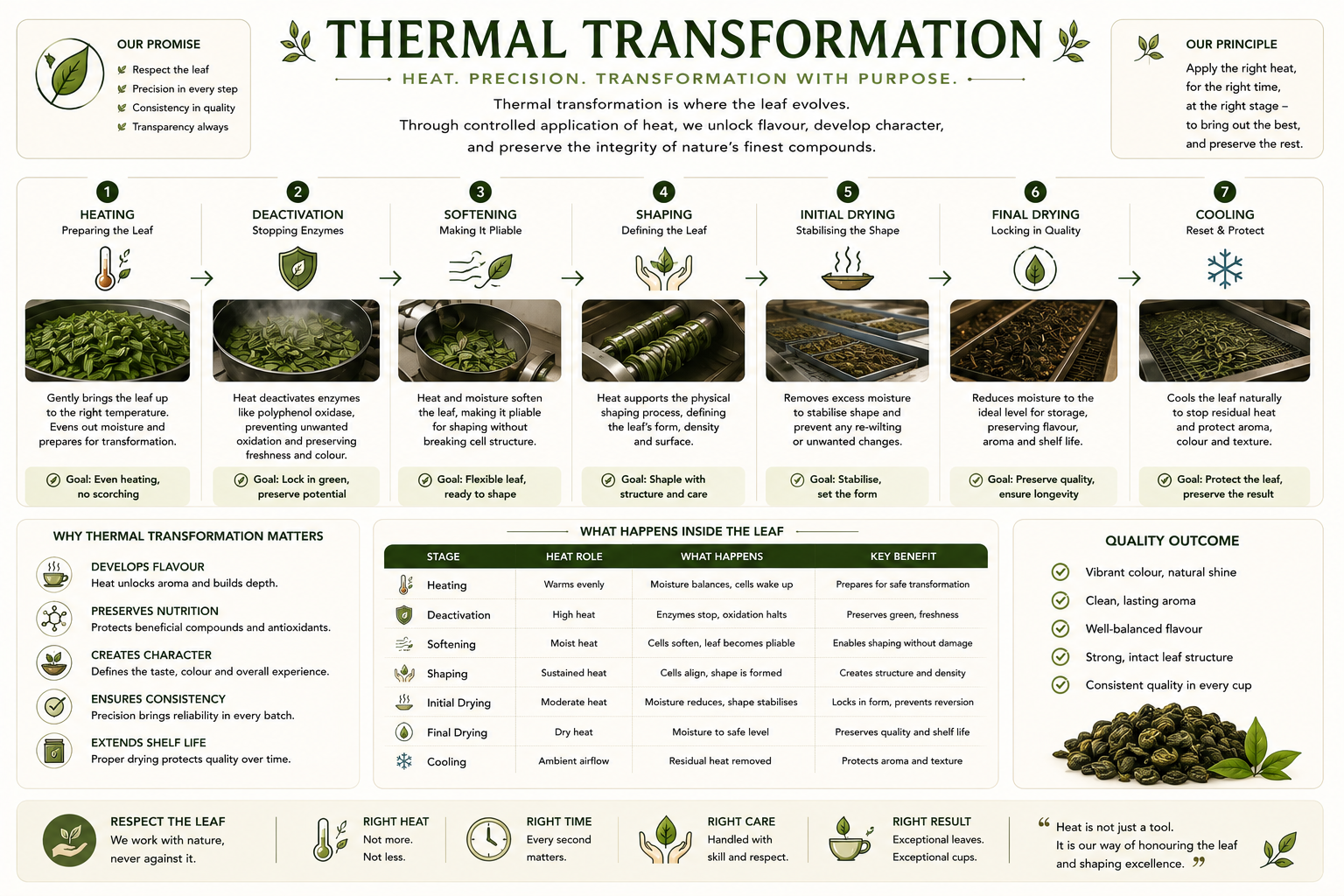
Seven stages of heat application in Buna processing — from enzymatic transformation at ambient temperature to the outer boundary of thermal development.
Tap image to view full board.
Citane processing at Thumpassery uses oven drying at 70°C as the standard research baseline. Pan roasting and smoke drying are documented in the Kuti and Kawa Daun traditions. Thermal precision is one of the areas where Citane is actively developing its own framework.
The leaf is worked without applied heat. Enzymatic activity is active. Withering, rolling, and fermentation all occur in this stage. Enzymatic action is the primary transformation force.
See Withering →ResearchGentle warming. Begins to slow enzymatic activity without fully arresting it. Used for controlled drying of fermented styles and some white-style preparations.
None →The temperature range at which polyphenol oxidase (PPO) is denatured and enzymatic oxidation ceases. The leaf is locked in its current chemical state. This stage is used to produce green-style Buna.
None →Extended moisture reduction without deep thermal transformation. Stabilises the leaf for storage. Standard oven drying temperature in published Buna research (Fibrianto et al. 2025).
None →Maillard reactions begin above approximately 120°C. Amino acids and reducing sugars interact to produce toasted, nutty, and caramel character. The first stage of deliberate flavour development by heat.
None →Trigonelline begins to degrade, contributing pyridine notes. CGA lactone formation adds structured bitterness distinct from raw CGA. Roasted character develops. Pyrazines emerge at trace levels (Steger et al. 2022).
None →The outer limit of useful thermal transformation. Beyond this, compounds degrade rather than develop. A useful marker — the boundary between deliberate roasting and damage.
None →In extended wet heat (decoction), perceived sweetness may increase and perceived bitterness may decrease as decoction time extends. This pattern is the opposite of what happens when Camellia sinensis tea is over-steeped. Published brewing optimisation research (Fibrianto et al. 2024) supports this direction of effect, though the precise mechanism and the conditions under which it applies require further study. It should not be stated as a universal law — it is a documented pattern in specific preparations.
Rapid heat application to arrest enzymatic activity and preserve the leaf in a green state. The Buna equivalent of Japanese steam-fixation in green tea. Speed matters — delay allows oxidation to begin.
None →Dry-heat roasting in a flat pan. Surface contact and flip-based technique. Used in Kuti tradition for the flat-pan preparation. Creates even surface browning without charring.
None →Simultaneous drying and smoke infusion. Kawa Daun tradition. Cinnamon wood creates a distinctive aromatic signature in the dried leaf through volatile compound absorption.
None →Controlled temperature drying. Research standard (70°C / 4 hours in Steger et al. 2022 and Fibrianto et al. 2025). Consistent enzyme arrest and volatile retention.
None →