Tap image to view full board.
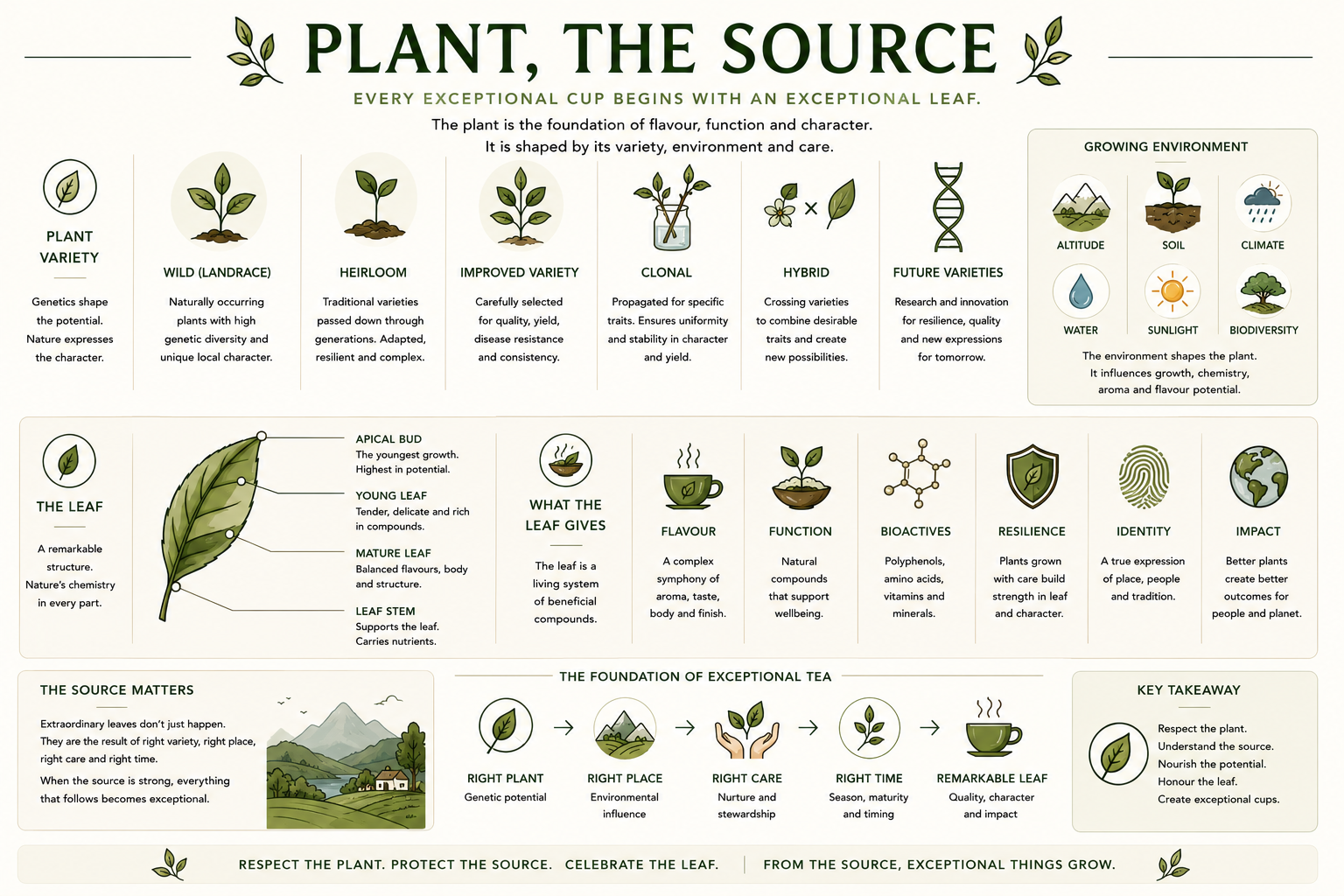
The plant is the foundation of flavour, function, and character. Variety type and leaf anatomy together determine what the leaf is capable of becoming.
Tap image to view full board.
Citane uses Arabica Chandragiri — an improved variety selected for performance in Kerala's lowland, rubber-shaded conditions. Its leaf anatomy and compound profile reflect both its genetics and its growing environment.
Naturally occurring coffee plants with high genetic diversity. Not selected for commercial production. Carry unique local character and important reference points for understanding species potential.
None →Traditional varieties passed down through generations. Adapted to their local environment, often complex in flavour, resilient without external inputs. Carry the memory of a place and practice.
None →Selected for specific qualities — yield, disease resistance, consistency. Citane uses Arabica Chandragiri, an improved variety for Kerala conditions. Trades some genetic diversity for predictability.
None →Propagated vegetatively from a single parent to ensure genetic uniformity. Consistent character batch to batch. Reduces genetic resilience over time.
None →The result of crossing two distinct varieties to combine desirable traits. First-generation hybrids are often vigorous; maintaining traits across generations requires careful management.
None →Varieties currently in development — bred for climate resilience and quality. As growing conditions shift, future variety development is essential for long-term coffee leaf production.
None →The youngest growth at the branch tip. Highest in certain bioactive compounds. Most tender and most delicate to handle. In some preparations, the most prized part of the plant.
None →Leaves immediately below the apical bud. Tender, rich in active compounds, bright in flavour character, more perishable than mature leaves.
None →Fully expanded leaf with complete structure. Balanced flavours, more body, denser compound profile. More robust and forgiving in processing.
None →The short stalk connecting leaf blade to branch. Carries water and nutrients. In processing, stems are sometimes removed to alter extraction behaviour; in others, retained as part of whole-leaf character.
None →A complex interplay of aroma, taste, body, and finish. Coffee leaf flavour is distinct from both coffee and tea — shaped by its own compound profile and its own processing logic.
See Flavour & Aroma → ResearchPolyphenols, chlorogenic acids, mangiferin, caffeine, GABA, and other compounds present in the leaf. Profiles vary by variety, altitude, leaf age, and processing method.
None →The leaf as an expression of place, people, and tradition. Citane's identity as a rubber-shaded lowland Kerala leaf is unique — no other producer can replicate it.
None →