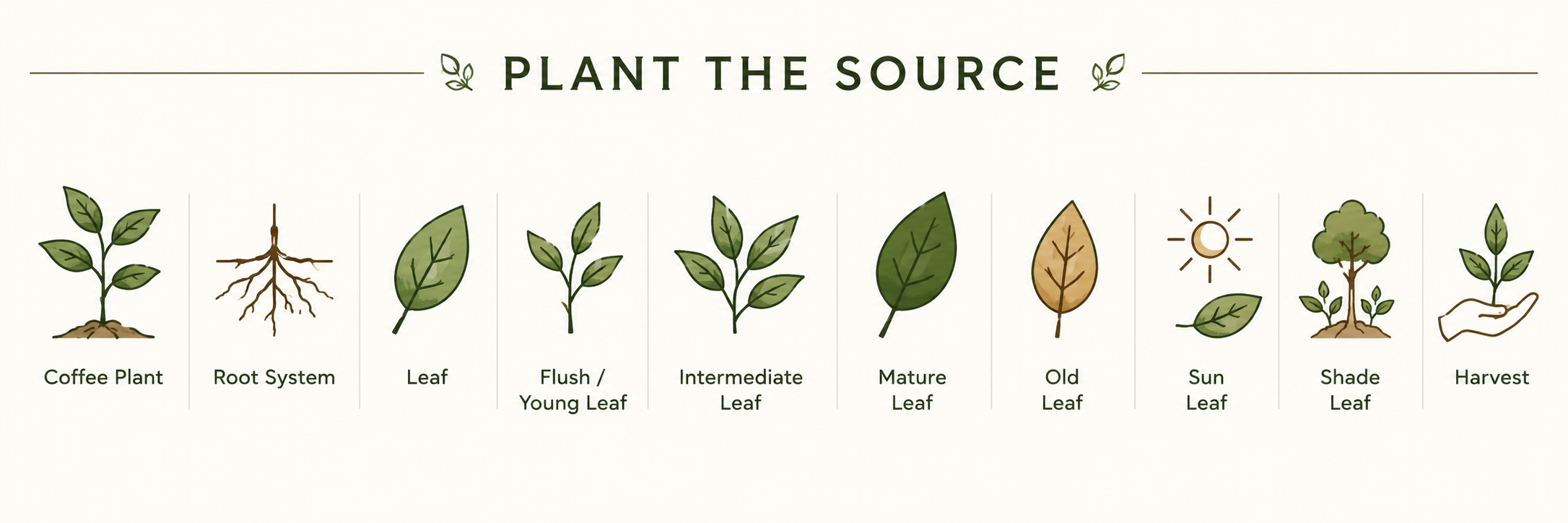
The coffee plant and its leaf stages — from the root system underground to the hand that harvests. Understanding these stages is the foundation of informed processing.
Chandragiri Arabica grown beneath mature rubber canopy at approximately 130 m elevation in Karavaloor, Kerala. A shade-grown, lowland leaf. Its leaf stages and physical character reflect this growing environment.
The whole plant as a living system — roots, stem, branches, and leaves. The health, variety, and growing environment of the plant determine everything that follows in the cup.
See Leaf Origin → ResearchThe underground network responsible for water uptake, mineral transport, anchorage, and soil interaction. Root health directly determines what the leaf above it can become.
See Plant Care — Root Health → ObservedThe individual coffee leaf — the primary unit of Buna. Each leaf is a self-contained system of chlorophyll, water, compounds, and structure. Not all leaves on one plant are equal.
The newest growth from the branch tip. Tender, light green, still expanding. Higher in certain bioactive compounds, more delicate in structure, more perishable after harvest. Requires gentle handling.
See Flush Cycle → ResearchA partially expanded leaf that has not yet reached full maturity. Offers a balance between the brightness of flush and the body of mature leaf. Often optimal for specific Buna preparations.
A fully developed leaf — deep green, firm, structurally complete. More robust under processing than younger leaves. Higher in tannins. The primary material for most Buna processing pathways.
See Selective Harvest → ResearchA leaf past its peak — yellowing, losing chlorophyll. Generally not used for premium Buna. Knowing when a leaf crosses from mature to old is part of selective harvest skill.
See Quality at Source → ObservedLeaf size reflects growing conditions and variety. Size affects surface area for extraction — consistency within a batch matters for uniform brewing results.
None →Leaf material fragmented at harvest or during processing. Extracts faster and less uniformly than whole leaf. Typically separated at sorting and directed to filter or concentrate formats.
See Sorting → ObservedSun leaves are thicker with higher photosynthetic activity; shade leaves are more delicate with a different compound balance. Citane is shade-grown under rubber — this is part of its identity.
See Leaf Origin — Sunlight → ResearchIn tea, the flush is consistently prized. In Buna, the relationship between leaf stage and cup quality depends on the processing method, the tradition being followed, and the flavour target. Knowing the stage is the first conversation in Buna quality.