Tap image to view full board.
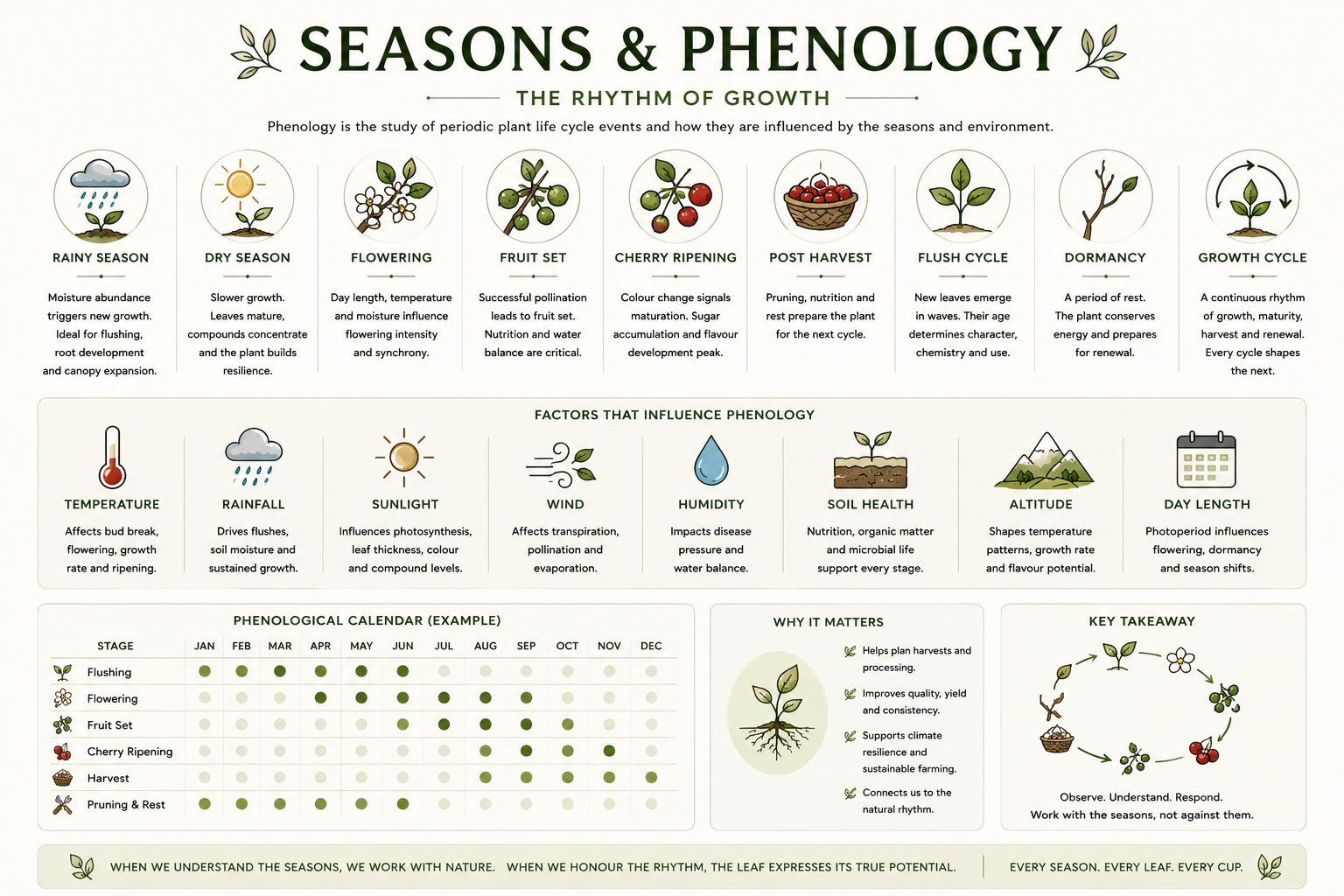
Phenology is the study of periodic plant life cycle events and how they are influenced by seasons and environment. Understanding it determines when the best leaf is available.
Tap image to view full board.
Kerala's two distinct monsoon seasons drive the flush rhythm at Thumpassery Estate. The southwest monsoon (June–September) and the northeast monsoon (October–December) create a year-round but seasonally variable pattern of growth and rest.
Moisture abundance triggers new leaf growth and canopy expansion. The primary flush season. Kerala's southwest monsoon (roughly June–September) is the main rainy season for Citane.
None →Growth slows. Leaves mature and the plant concentrates compounds. Dry season leaves may carry a denser, more concentrated character than rainy season equivalents.
None →Coffee flowers are brief, fragrant, and triggered by the transition from dry to wet conditions. Flowering synchrony depends on temperature and moisture. Energy is partially redirected from leaf production.
None →Successful pollination leads to cherry development. Nutrition and water balance are critical. The plant's energy budget during this stage affects leaf production in parallel.
None →Colour change signals maturation and sugar accumulation. High demand on plant resources during this period. Leaf quality during ripening reflects the energy competition.
None →After cherry pick, the plant recovers and prepares for the next cycle. Pruning, nutrition, and rest during this window set the foundation for the following season.
See Pruning → ObservedNew leaves emerge in waves, triggered by rain after a dry period. Each flush has a different character and harvest window. Age at harvest determines compound profile and processing suitability.
See Flush / Young Leaf → ResearchA period of reduced metabolic activity. The plant conserves energy and prepares for renewal. In Kerala's climate, dormancy is partial rather than complete.
None →The complete rhythm of growth, maturity, harvest, and renewal. A well-managed cycle produces consistent leaf quality across years.
None →Affects bud break, flowering, growth rate, and cherry ripening. Warmer temperatures accelerate all stages. Temperature variation between seasons is a primary phenological driver.
None →Drives flushes, sustains soil moisture, and supports growth. Rain after a dry period is one of the most reliable triggers for new leaf flush.
None →Influences photosynthesis, leaf thickness, colour, and compound levels. Day length also plays a role in triggering flowering and dormancy transitions.
None →Impacts disease pressure and water balance within the leaf. Kerala's high ambient humidity is characteristic of the Citane growing environment.
None →Nutrition, organic matter, and microbial life support every stage of the phenological cycle. A depleted soil cannot sustain peak leaf production.
See Soil Health → ResearchShapes temperature patterns, growth rate, and flavour potential across the full phenological cycle. Citane at 130 m operates in a warm, fast-moving phenological rhythm.
None →Affects transpiration, pollination, and evaporation. Moderate air movement supports pollination and reduces disease pressure.
None →Photoperiod influences flowering, dormancy, and seasonal transitions. In near-equatorial Kerala, day length variation is moderate but still biologically significant.
None →Observe. Understand. Respond. Work with the seasons, not against them. When we understand the seasons, we work with nature. When we honour the rhythm, the leaf expresses its true potential.